

The US, Canada, Japan, France, the UK, the Netherlands… and Spain. Activist funds have long been very active in Spain’s listed companies, where they hold positions worth almost $4 billion according to the latest report from Sodali, which cites the case of Third Point in Indra. However, it is in a company without a clear majority shareholder, Cellnex, where TCI, with a 9.3% stake, has managed to impose its rules.
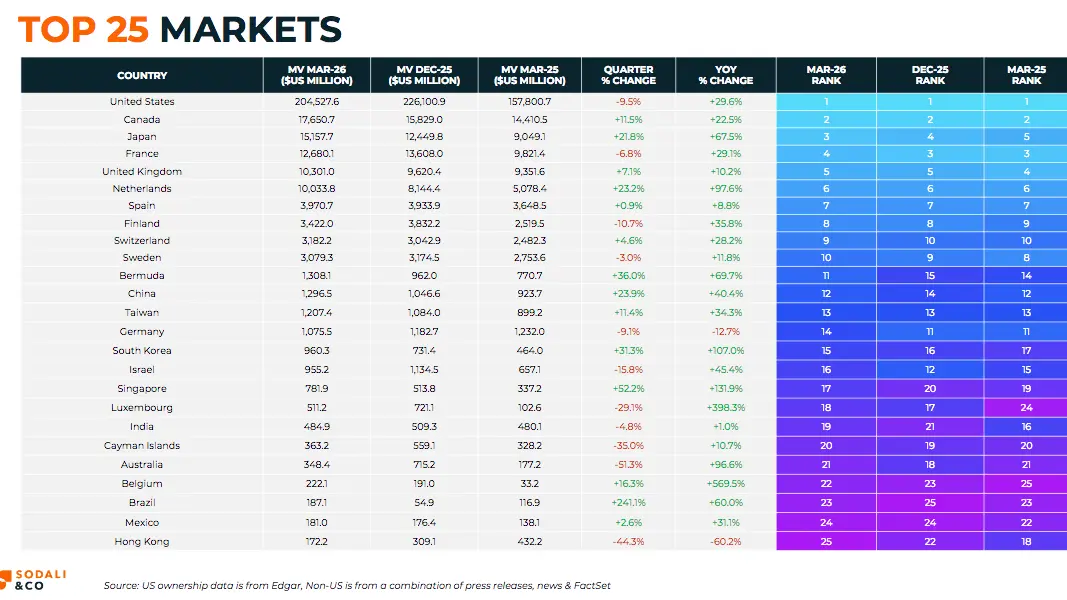
Spain ranks as the seventh largest market in the world – in terms of the market value of positions held by activist investors – according to the ‘Sodali 40’ report, which estimates the aggregate value of these investments in Spanish companies at $3,970.7 million at the end of the first quarter. This means that, within the European context, Spain is the fourth market with the highest level of activist penetration, behind only France, the United Kingdom and the Netherlands.
The value of activist positions in Spain shows a year-on-year growth of 8.8% (comparing March 2025 with March 2026), although on a quarterly basis, it remained relatively stable with a slight increase of 0.9% compared to December 2025.
The report specifically mentions the activities of Third Point, the US fund that holds a stake in Indra and actively supports the creation of a ‘Spanish defence rollup’. Although the fund led by Dan Loeb claims to hold less than 3% of the capital – which means it is not required to disclose details of its stake – it has threatened a fall in the share price if Indra does not proceed with its merger with EM&E, the company owned by the Escribano brothers.
But the most prominent example of corporate activism in Spain is undoubtedly the position taken by the British fund TCI (The Children’s Investment Fund) – led by the billionaire and activist investor Chris Hohn – in Cellnex Telecom in recent years.
TCI is one of Cellnex’s key shareholders, the second-largest shareholder with a 9.38% stake, second only to the Benetton family through Edizione, which holds around 9.9%.
TCI’s role in Cellnex is a textbook case of successful shareholder activism:
In early 2023, TCI burst onto the scene as the main shareholder and launched an aggressive campaign against the board of directors of the telecoms tower company. Chris Hohn harshly criticised the handling of the succession of the then CEO, Tobías Martínez, accusing the board of a “lack of progress” and of mismanaging the process.
TCI demanded (and secured) radical changes in record time:
- The dismissal of the then non-executive chairman, Bertrand Kan.
- The departure of several independent directors.
- The appointment of Anne Bouverot as the new chair of the board.
- Securing a seat on the board for its representative, Jonathan Amouyal.
TCI’s aim was not merely to change faces, but to force a 180-degree shift in Cellnex’s business model. Historically, Cellnex had grown very aggressively by purchasing thousands of mobile phone towers across Europe, financing this with a large amount of debt.
With the rise in global interest rates, TCI pressed for a halt to the massive acquisitions and a shift to a strategy dubbed ‘The Next Chapter’, centred on:
- Reducing debt: Focusing on financial discipline to achieve and maintain an investment grade credit rating from agencies such as S&P.
- Sale of non-strategic assets: To accelerate deleveraging, they supported the sale of Cellnex’s businesses in countries such as Ireland (for nearly €1 billion) and Austria.
- Shareholder returns: Changing the allocation of free cash flow (FCF). Once the balance sheet has stabilised between 2024 and 2025, the focus has shifted to share buybacks and increased dividends.
Following the appointment of Marco Patuano as CEO (an executive very much in line with the demands for efficiency and capital control), the waters seem to have calmed.


