
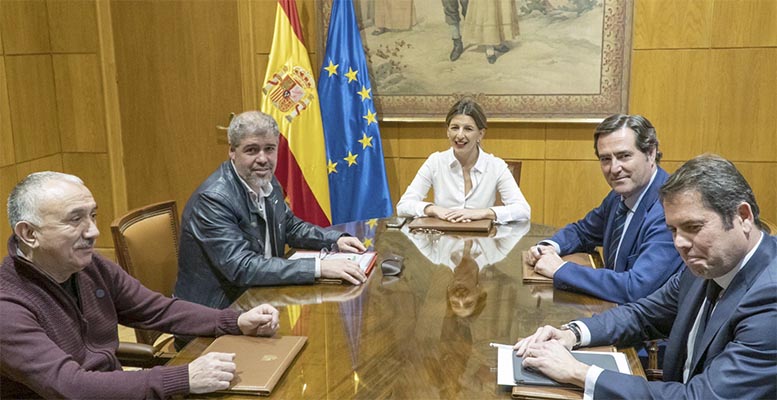
It has been years since tripartite social dialogue—between the employers’ association, trade unions, and the Government—broke down due to the Government’s insistence on relying solely on the unions. The unions have called a general strike—’against the opposition,’ as explained by the PSOE—for November 11, two days before the electoral campaign begins. Thus, the Ministry of Labor and Social Economy under Vice President Yolanda Díaz—a card-carrying communist who a few days ago called for mobilizations against the Government—has convened today, Thursday, a meeting of the advisory committee for the Minimum Interprofessional Wage (SMI) with the objective of finalizing the increase for 2027 before the general elections on November 29.
Work is thereby underway to agree on an SMI increase promised by Minister Yolanda Díaz, which could be approved during the current legislature. The Ministry has repeatedly conveyed the need to adapt the SMI to the rebound in inflation—at 4.9%—to prevent a loss of purchasing power, a demand maintained by the unions over recent months that legally justifies the upcoming call for a general strike.
Now, the SMI committee will issue a report proposing an increase range, which will subsequently have to be negotiated with the social partners and CEOE, although the latter has not participated in the pact for the last six SMI increases. Once agreed upon, the increase must be approved by the Council of Ministers.
The latest SMI increase was approved by the Council of Ministers on February 17, 2026, retroactive to January 1, establishing the SMI at 1,221 euros per month in 14 payments following a 3.1% increase. The minimum wage has thus become the most common among Spanish workers (16,520 gross euros per year, which, after deducting Social Security contributions, sits—depending on the worker’s circumstances—between 1,103 and 1,120 euros per year [or month], across 14 payments).”


