

Search Results for deflation

No Picture

Is ice between ECB and Bundesbank melting?

MADRID | By Julia Pastor | The Bundesbank must be really worried about euro zone’s economy evolution. The German central bank’s chairman Jens Weidmann, paradigm of the country’s economic orthodoxy, opened the door to an ECB’s eventual bond purchase program for the first time in order to fight against common currency’s appreciation and the ghost of deflation. Furthermore, the German economy, strongly linked to Ukrainian interests, could suffer a downturn in the 2Q14, according to Bundesbank’s estimations. Meanwhile, the ECB could be studying some operational and legal points to start the stimulus program.

No Picture

Shiller backs Abe and Roosevelt… what’s Merkel say on that?

MADRID | By Luis Arroyo | Nobel laureate economist Robert Shiller discusses the issue of the so-called “animal spirits” and what should be done in order to pump trust. He uses a visit to Japan as a base to show how effective the politics by Mr. Abe were. Japan is the country that has reduced the gap with the potential GDP.


No Picture

Spain Wants A More Efficient Tax System- But Will It Be Socially Equal?

MADRID | By Julia Pastor | Spain could cook a historical fiscal reform to simplify complex patchwork of tax rates at national and regional level- there are more than 1,000 tax exemptions, even more than in the UK, which was the European country with the highest freedom from taxation-, and increasing revenue collection efficiency. Spanish market watchers are looking forward to see reforms in the 444 pages report presented to the cabinet by an experts committee. However, critics fear that social policies, especially those focused on employment, quality of labour force or further specialization, will be ignored. As the rest of euro zone’s southern countries walk over the same path of Spain’s, a real harmonized fiscal union still seems too far.


No Picture

Spain’s Warning Signs Of Japanisation- Shall We Buckle Up?

MADRID | By Julia Pastor | Amid the debate on the euro zone’s eventual japanisation due to low inflation levels, we wonder if Spain could be the first member state with severe signs of this illness. Inflation is near 0% since six months ago and markets’ expectations suggest an average price index scarcely over 1% for next five years, and under 2% in a decade. Along with Portugal, Spain is the EU economy having more price indicators’ components in red year-on-year rates, namely 40% against 20% of Europe’s average. That means that 2 out of 3 goods in Spaniards’ shopping basket are affected by deflation. Although good for the country’s competitiveness, there is a risk in the process of public as well as private debt deleveraging.


No Picture

Today’s Talk Of The Market In Spain

MADRID | By Jaime Santisteban | BBVA takes a look on the bright side of the Spanish economy in 1Q14: growth, exports, domestic demand, labor market, public spending reduction. Santander urges the EU to hasten arrangements on SRM to meet Banking Union agenda. Otherwise, stress tests won’t have credibility.


800px George Soros World Economic Forum Annual Meeting 2011 1560x690 c

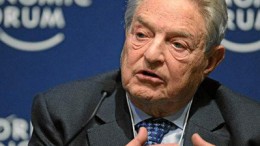
Soros: “German Parliament Imposed Wrong Discipline On Spain”

MADRID | By The Corner Team | Greek billionaire, investor, philanthropist and speculator Geoge Soros is well known for his pessimissm towards the euro and his enthusiasm for getting headlines. During a visit to London for his book tour, he made a case against the excess of austerity in the eurozone and critizised the recipes imposed by the German Parliament on its neighbours like Spain.


No Picture

A too much strong euro for such a weak euro zone

MADRID | By Francisco López | The climbing of euro against U.S. dollar is increasingly worrying market strategists as it can affect negatively prices and loss of competitiviness in the euro zone. Conversely to the ECB, which has decided not to intervene exchange rate. “It is out of our mandate,” Draghi assured last Thursday, “unless it damages prices’ stability expectations or economy growth.”


No Picture

Inflation indexing and Bitcoin rhetoric

FRANKFURT | By Dr. Beate Reszat | The other day, the New York Times provided us with an example of how fads and fashions can be used to draw attention to, and win acceptance for, an economic argument. In his article ‘In Search of a Stable Electronic Currency’ Nobel laureate Robert Shiller proposed the introduction of an inflation-indexed unit of account similar to the Chilean unit of development or unidad de foment (UF) which is existing since the 1960s. The article is in large parts a summary of the ideas of an academic paper the author published in 1998. In short, its main argument says that recent progress in computer technology has considerably widened the possibilities of inflation indexing which would allow for a better pricing, contracting and risk management in an economy.


No Picture

Today’s Talk Of The Market In Spain

MADRID | By Jaime Santisteban |  Action from the ECB to favor growth and liquidity would be welcomed  in the euro zone, where GDP boosted by 0.2 % in 4Q13 after dropping by -0.3% in the prior term. Meanwhile, Sacyr will contribute €30 more million  in guarantees to wrap up agreement in Panama and airline Iberia gets to balance offer and demand. Finally, Ibex 35 appreciated by 1.96 % in February and by 1.99 % year-to-date, according to our exclusive market consensus Consenso del Mercado.


No Picture

Reasons for the ECB not to make a move

MADRID | By The Corner team |  Neither the recovery of euro zone leading PMI services index, nor the stability of low inflation levels or financial conditions favouring all the region, including peripheral countries, would justify new significant monetary stimulus from the European Central Bank in today’s meeting. Furthermore, there is not a consensus even within the ECB itself. “Just the continuing appreciation of the euro could make the ECB to take action”, Renta 4’s analysts in Madrid said earlier this morning. As regards central bank’s expectations on inflation up to 2016, Draghi will probably confirm they will continue to be firmly anchored in the medium term, even though levels in the short term are very low.