
Germany

German court

ECB’s OMT: The trick in German Constitutional Court’s sentence

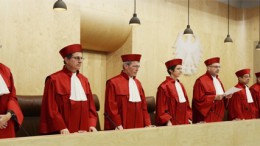
MADRID | By Luis Arroyo | Germany set off a time bomb against the euro by transferring from the country’s constitutional court to European Court of Justice the decision about “legality” of ECB’s Outright Monetary Transactions’ program. Some Spanish analysts appear to be pleased with the sentence, contrarily to common sense: it is good that German Court starts to agree the European Union’s. They say that recognising Europe’s jurisprudence assures Community law’s unity. God bless their innocence.


European Union

EMU banking : well-behaved vs rogue systems?

MADRID | By Luis Martí | The European banking union project received a remarkable boost last December, even if a major chapter, the bank resolution fund, had to conform to German requirements and stay on a national basis. This part of the agreement is a moot point, and Southern countries should have raised their voices and taken a firm stand against, as Münchau also wrote, no matter the delay inflicted to the working agenda of the eurogroup.


No Picture

Paid Corruption In Germany: The Pofalla Case

FRANKFURT | By Lidia Conde | What happens when the supervisory board in a company discovers that its president conceals his intentions of improving the relationship with the political power by hiring Angela Merkel’s “man of confidence”? That’s what has happened in Deutsche Bahn, the German railway, whose supervisory board learned from the press that Ronald Pofalla (Merkel’s cabinet chief barely two weeks before) was joining the governing board.


Germany employment

Germany Employment Rate Shows a Brighter EU Face

BERLIN | By Alberto Lozano | While the euro zone jobless rate reached 12.1 percent in October, Germany has promising news for itself: national labor market is expected to create about 180,000 jobs in 2014. Why is this happening? 


No Picture

Germany, the Same Ol’ Song

MADRID | By Luis Martí | In Germany, coalitions are frequent at all levels of government, with a degree of formalization and publicity which was minimum before (in the Adenauer Era), but which has shown an extensive “coalition contract” since 1969. The current contract, initialled on 27 November, has yet to be ratified –and it’s expected that the process will be brief where the CDU and the CSU are concerned, but not so much in the case of the SPD, which must be subject to a vote of approval by its affiliates.


germany can longer serve as a model to Europe

Germany can no longer serve as an example to Europe

BERLIN | By Presseurop| The contract for a new grand coalition government between Angela Merkel’s Christian democrats and the Social Democratic Party, which was presented on November 27, has not met with much enthusiasm in the German press. For some, the long-awaited deal is too generous to the left, while others argue that it fails to take into account the interests of Europe.


EU has resigned to mediocrity

EU has resigned to mediocrity

MADRID | By Fernando G. Urbaneja | The present crisis is punishing the Europeans more than anyone else, although Germany is quite well. However, the scarce economic growth, high unemployment rates, and questionable living conditions of the society lead to think that the EU has resigned to mediocrity.


Germany1

Bundesbank Warns of Housing Bubble; Germans Blame ECB

BERLIN | By Alberto Lozano | Housing prices in Germany have skyrocketed since 2010 -in big cities prices up to 25%, according to the Bundesbank, which points out overvaluation could reach 20%, giving “ise to fears of a broad-based property price boom.” Germans are already pointing to the ECB as the main culprit.


EU recovery loses steam

EU recovery loses steam

MADRID | By JP Marin Arrese | One day after the European Commission put Germany under close scrutiny, blaming its fat trade surplus of curtailing other countries’ growth, figures released on economic performance in the third quarter came as a nasty surprise. Exports had stalled in the biggest partner, bringing growth rate to 0.3% down from 0.7% three months before. Resilience in internal demand had saved it from shrinking, openly contradicting Brussels’ claims against Berlin.