
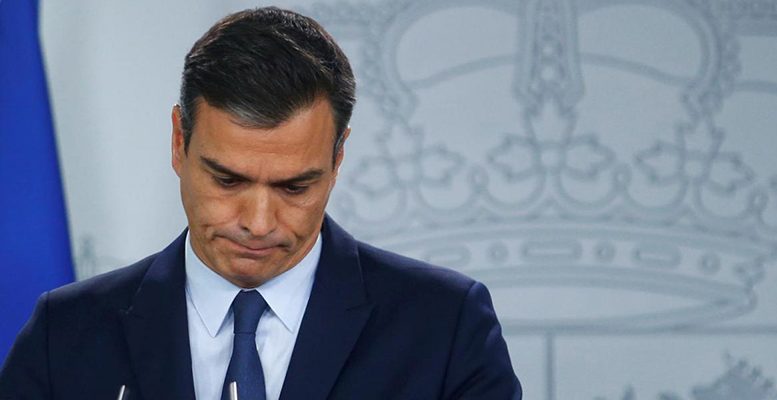
On November 29, Spain will vote in a general election. This is the announcement made today by Prime Minister Pedro Sánchez, who last Friday suffered two new and severe defeats in Parliament that proved he has never enjoyed a parliamentary majority during this term, which comes to an end without having presented a single budget.
“We need a much broader majority,” explained Sánchez, certifying yet another lie, given that he does not hold any majority at all. “At last,” said opposition leader Alberto Núñez Feijóo, who pledged to tear down the wall that the current prime minister declared he would build on the very day of his investiture.
According to the opposition leader, it is the fear of corruption that has yet to be exposed that has pushed Sánchez to call an election now—an election that, according to all polls, will allow him to stay above one hundred seats at the cost of capturing all the votes from the far left that had previously governed in coalition with the PSOE. It is a far left that appears willing to vote for Sánchez after the successive disappointments posed first by Izquierda Unida, then Podemos (Pablo Iglesias and Irene Montero), and now Sumar, led by Yolanda Díaz—a vice president who claims to be a communist and who last week called on people to mobilize… against the government of which she is a member.
On the other side of the spectrum, the radical right party Vox is bordering on 20% of voting intention after disasters such as the one in Ceuta capped off an erratic migration policy that has enabled the entry of half a million immigrants a year and an express regularization process that two million people have signed up for.
With inflation at 4.9%, runaway taxes (personal income tax brackets have not been adjusted for inflation in years), and housing completely unaffordable… the government boasts of growth based on immigration and public spending, which nevertheless fails to prevent a public deficit close to 3% and a public debt at 100% of GDP.
Today, polls give nearly 200 seats—out of the 350 in the Spanish Parliament—to the combined total of the PP (around 140 seats) and Vox (around 60 seats), leaving little more than 100 for the PSOE and no more than 15–20 for the remaining far-left forces. We shall see what happens on November 29.


