In the World

US jobs

US Strongest Surge Of New Jobs Since 1939, But No Major Surprise

Janwillem Acket (Chief Economist, Julius Baer) | Even though the June figure of overall non-farm job creation in the US (to which all the major segments of the economy contributed) is a historical high since the records started in 1939, there are bitter aftertastes. In fact, continued jobless claims until 20 June, i.e. during the period of data collection for the non-farm jobs, actually rose to 19.29 M, from 19.231 M a week earlier, and the four-week average until 27 June was still at 1.504 M, only slightly down from 1.621 in the previous week.


UST10Y 10YGerman Bund

U.S. Treasuries Watch: Thinking Globally

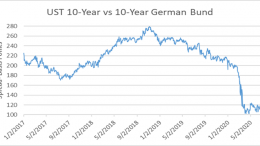
Kevin Flanagan, Head of Fixed Income Strategy, WisdomTree | While we don’t envision the UST 10-year yield revisiting the aforementioned 2018/2019 levels any time in the foreseeable future, it no longer has the same tailwind speed ‘at its back’ when ‘thinking globally’.


Indonesiaok

Indonesia Debt Monetization: Not Inflationary But Plenty Of Baggage And Not Doing Much To Help Growth

Trihn D. Nguyen (Natixis) | Currently, 32% of government bonds are held by foreign investors and the price of that debt is 5.4% for the 2-yr and 7.2% for the 10-year. Even after Bank Indonesia (BI) embarked on rate cuts of 75bps in 2020 to 4.25% and outright purchases of government bonds, the government is asking the central bank to take one step further and buy 60% financing needs in 2020 at zero interest.


gold can be considered a sound currency, as the "ultimate means of payment".

The Gold Rally Continues

Carsten Menke, Head Next Generation Research, Julius Baer | The gold rally continues. Prices pushed higher yesterday, approaching USD 1,800 per ounce for the first time since 2011. Looking back, there were just 26 days in gold’s history on which it traded above that level, almost all of them occurring in August and September 2011, i.e. during the eurozone debt crisis. Holdings of physically backed gold products, our preferred gauge of safe-haven demand, recorded 95 tonnes of inflows in June, taking the year-to-date total to more than 710 tonnes. These are the biggest inflows ever. 


renewables toreras

BofA: “We stay overweight France, Spain and Italy.”

BofA Global Research | We stay overweight France, Spain and Italy, as they should benefit from a continued rebound in PMIs. We raise the UK to marketweight after the recent undershoot. We remain marketweight Germany, as it discounts much good news. We are underweight Switzerland, as it tends to underperform when improving growth momentum lifts bond yields.


frankfurt sklyline

A V-Shaped Bounce In Q3 GDP Is Possible

Chris Iggo (AXA Investment Managers) | The second quarter was disastrous for society and the global economy. The danger on both fronts is passing only slowly. Yet the quarter was great for markets. Barely any asset class delivered a negative return. Trillions of dollars of money was created and central bank balance sheets boomed. It has been a lesson in not underestimating the power of policy. Cheap valuations and rocket-fuel policy drove risk assets. The starting point for Q3 is not quite the same. Where fundamentals go is much more important now.


hollywood

California, Texas And Florida: The States Hit Anew By Covid-19 Account For 28.5% Of US GDP

In the US, although the figures are deteriorating in just 16 of 50 states, the problem lies in the fact that this group is made up of some of the most relevant from an economic perspective: California, Texas and Florida. But while the proximity of Independence Day celebrations is perceived as a potential risk for an explosion of new infections, the reality is that fine tuning measures are being advocated and large-scale closures will be avoided at all costs in the US and elsewhere in the world.


consumption recovery 1

Consumption: Support Point For Recovery

José Ramón Díez Guijarro (Bankia Estudios ) | The first weeks of the opening of the economies are serving to gauge the response of consumption, a key variable in determining the profile and intensity of the recovery. In the US, the fiscal programmes for aid to families injected more than 300 billion dollars into disposable income in the second quarter. In Europe, instead of using direct aid as in the US, they have preferred to activate temporary employment suspension programmes (ERTE in Spain, kurzabeit in Germany, etc).