World economy

EconomicSituationIndex

How, For The USA, To Find A Balanced Momentum After Such A Shock?

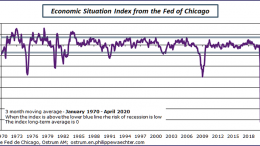
Philippe Waechter (Natixis AM) | The CFNAI index, calculated by the Chicago Fed, is the best measure of the economic situation as it is. It is a composite of 85 indicators published in one month. It includes industrial production, retail sales, employment and many more. It is published late compared to the surveys, but it perfectly reflects the state of the business cycle. It reads on average over 3 months and when it is greater than -0.7, the probability of recession is almost zero. Below this threshold, the risk of recession is high. See here for more details. In April, the index dropped more than 10 points to -16.74 from -4.97 in March. Its three-month average was -7.22 compared to -1.69 in March. The indicator is well below the threshold of -0.7. As the graph shows, The index is also well below the measures observed in 2008/2009. The shock is of a different kind and magnitude never before seen. This curve has the same pace as that of employment which in April contracted by 20.5 million.


re opening corporate debt

The Vulnerabilities Of Corporate Debt In The Face Of A Historic Shock

Ricard Murillo Gili (via Caixabank Research ) | The paralysis of economic activity will lead to a fall in global GDP not seen since 1930. Are there latent financial fragilities that could amplify this decline? In a more demanding financial environment, the high levels of debt will be put to the test, its quality will deteriorate and mechanisms that amplify economic stress could be activated due to the interconnections that exist between different assets.


Mexico's elections to be held on 1 July

The Mexican Economy Shrank By 1.2% In Q1

Olivia Álvarez (Monex Europe) | The Mexican economy shrank by 1.2% in Q1 on a quarterly basis, or 1.4% when compared with last´s year same period (not seasonally adjusted). The fallout in Q1 follows a series of 5 quarterly contractions over the last year and a half, further deepening the ongoing economic recession in Mexico. The coronavirus shock is mainly to blame for the Q1 contraction as external demand dropped sharply, with domestic activity only being affected in the last week of the quarter by the implementation of social distancing measures. Even so, quarterly GDP was dragged down to its worst performance since the financial crisis in 2009, with the March GDP contraction of 1.25% adding to a monthly decline of 0.59% in February and stalemate in January.


Leverage loans. The next trigger?

Inflation Is Impossible: The Speed Of Money Circulation Is At An All-Time Low

Miguel Navascués | The Fed is continuing to buy assets and issue money to chosen subjects (for the first time not just the banks). The purchases made so far are more than double those made in 2008. However, the speed of money circulation (i.e., GDP/M2), shows a decline to levels never seen before: each unit of money in circulation moves just $1.4 of GDP. Or, in other words, more and more money is needed to move the same amount of GDP.


pmi sector manufacturero marzo

‘Flash’ PMIs Showed That Economic Momentum Had Bottomed Out As Economies Reopen

David A. Meier (Julius Baer) | Preliminary purchasing managers’ indices (PMIs) show that economic momentum has bottomed out from record-low levels in May, after corona-containment measures were eased. Nevertheless, levels are still in contraction territory. Even if PMIs recover to expansion in the next months, it will take some quarters until growth is restored at pre-crisis levels.


new world order

Spotting The Winners In The New World Order

Emma-Lou Montgomery (Fidelity Investments) | The pandemic has slowed the global economy, it has also accelerated change in other areas that, in ‘normal’ times, would have probably taken months, if not years to come about and therein lies a source of opportunity for investors in particular. One obvious contender is retail. We are still very much in the midst of it all, but once the pandemic threat has passed sufficiently enough to allow the economy to fully reopen, the differential between high street and online retailers will become even more stark than before the pandemic.


The economic cold war between the US and China is here to stay

Losing Streak: US- China Trade Conflict

DWS | Trade wars are rarely good, and never easy to win. Instead, they tend to produce economic losses on all sides, causing both short-term pain and long-term damage. Recent trade conflicts between the United States and China may prove hard to reverse, harming U.S. consumers and businesses alike. As our “Chart of the Week” shows, Chinese exports to the United States have held up pretty well in value terms since both sides started to impose tariffs in July 2018.


Bitcoin record mark

Crypto Corner: Bitcoin Extends Losses

Adam Vettese (eToro) | Bitcoin has extended its losses this morning, with the cryptoasset losing another 0.5% to add to yesterday’s 4.5% fall. The key resistance level of $10,000 is proving to be a difficult hurdle to overcome, with several failed attempts this month. It is now back trading close to the $9,000 mark. Bears could see this as a sign the momentum may be shifting following the two month price rally.


china ave phoenix

China Chooses To Be Realistic And Refuses To Quantify Its 2020 Growth Target

China has decided that it will not set a target for economic growth for 2020, due to the uncertainty caused by the Covid-19 pandemic. This was announced by Chinese Premier Li Keqiang at the opening session of the National People’s Congress, the highest legislative body of the People’s Republic of China. The country will give priority to guaranteeing the population’s living standards, with job creation goals, reducing the unemployment rate to 6% and an inflation target of 3.5%.


Global Economy

Developing Nations Face Multiple Shocks With Uneven Ammunition

Irina Topa-Serry (Senior Macro Economist AXA Investment Managers) | The COVID-19 crisis is currently unfolding in emerging markets (EM). So far, they appear relatively less affected than their advanced economy neighbours such as the Eurozone or the US. But for some, it may be because they are only just entering the acceleration phase of the epidemic. For others, it may be because lockdown measures were implemented at an early enough stage, as seen in Slovakia. On a hopeful note, it may also reflect the demographic structure of some developing countries. For instance, slightly more than half of Africa’s 1.3bn population is under 19 years of age, versus just a fifth of Europe’s 740m inhabitants. At the other end of the scale, a quarter of Europeans are above 60 versus a mere 5% of Africa’s population.