
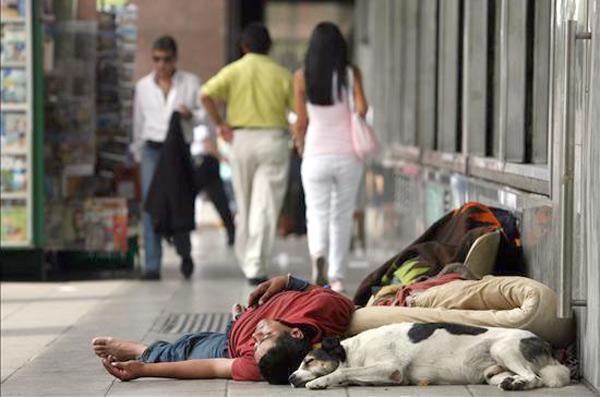
Thirty-three percent of people at risk of poverty in Spain are currently employed. This average percentage rises to 40% in the Balearic Islands, but does not fall below 25% in any Spanish region in 2025. Another third of Spaniards at risk of poverty are retirees or unemployed, while the final third has no known economic activity. These are some of the conclusions from the study “Analysis of Social and Economic Exclusion in Spain and its Territories,” published by the Ramón Areces Foundation and the Ivie (Valencian Institute of Economic Research), based on the Living Conditions Survey from the National Statistics Institute (INE) and other official data.
The risk of poverty is defined as having an income below 60% of the median (the value that separates the 50% of the population with the highest income from the 50% with the lowest), while extreme poverty or exclusion is defined as an income below 40% of the median. The average income of the population at risk of poverty in Spain was €4,869 per year in 2023, while for those at risk of exclusion, the average income in Spain was €2,849 per year.
According to the study, 20.2% of the Spanish population is at risk of poverty, and 8% suffers from extreme poverty or exclusion.
Although the poverty rate among the employed population has decreased from 14.8% in 2015 to 11.6% in 2025, it remains very high in several autonomous communities. In Andalusia, it reaches 17.4%, whereas in Navarre, the probability of people with jobs falling into the risk of poverty is only 6%.


