
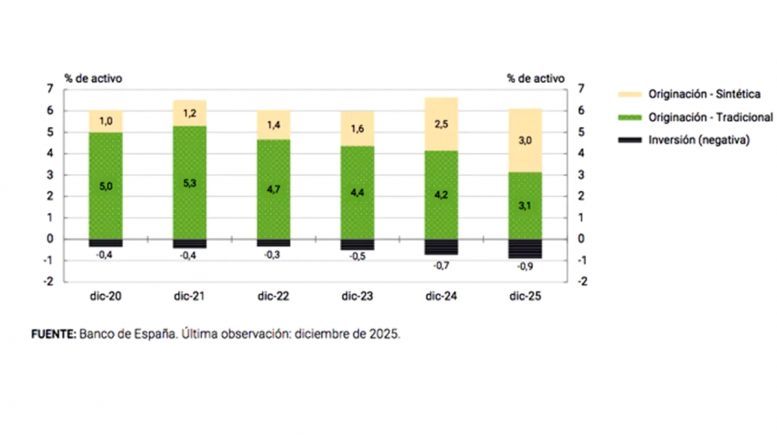
Synthetic securitisations – which allow underlying assets to remain on the balance sheet and enable banks to expand their balance sheets without increasing capital – now account for 3% of Spanish banks’ total assets.
By the Consejeros Editorial Team
The weight of synthetic securitisations on Spanish banks’ balance sheets continues to rise and now accounts for 49% of total securitisations. Just five years ago, in the 2020 financial year, they accounted for only 17% of the total.
Thus, whilst at the end of the 2025 financial year the outstanding balance of Spanish bank securitisations accounted for 6.1% of their total assets – which grew by 1% in 2025 – synthetic securitisations accounted for 3%.
Synthetic securitisations allow risk to be transferred without removing the underlying assets from the balance sheet, which ‘frees up’ own funds – by reducing the ‘density’ of risk-weighted assets (RWA) – and enables continued growth and balance sheet expansion without increasing capital.
As the Bank of Spain explains: “In a traditional securitisation, the originator transfers ownership of the assets off its balance sheet to an ad-hoc entity, which issues securities based on the cash flows from those assets. By contrast, synthetic securitisations involve the transfer of all or part of the credit risk to a counterparty, whilst the bank retains ownership of the underlying assets”.
According to the Bank of Spain’s analysis, “The ratio of the value of new origination transactions backed by loans generated in Spain to new credit transactions to households and businesses in Spain reached 12.2% in December 2025, 3.3 percentage points above the level observed in December 2024 and in line with the average for the 2020–2024 period (12.4%)”.


