
Articles by The Corner

About the Author

The Corner
The Corner has a team of on-the-ground reporters in capital cities ranging from New York to Beijing. Their stories are edited by the teams at the Spanish magazine Consejeros (for members of companies’ boards of directors) and at the stock market news site Consenso Del Mercado (market consensus). They have worked in economics and communication for over 25 years.
No Picture

There, but for the grace of ECB, go spreads

LONDON | By Soren Willemann at Barclays | Credit spreads (here, iTraxx Main) have a strong relationship to the ZEW survey of eurozone expectations for economic growth (Figure 1) over long time horizons. In the past months, however, this relationship has shown a significant disconnect: the ZEW survey reveals a material worsening of sentiment, whereas credit spreads have been largely unchanged.


greek banks

Greek banks may soon breathe sigh of relief on capital needs

ATHENS | By Manos Giakoumis via MacroPolis | Greek banks are always at the forefront of domestic market developments. Despite the strong rebound of 6.4 percent on Friday, their shares still recorded cumulative losses of 7.8 percent last week and 23.9 percent over the past three months. Concerns about the outcome of the upcoming comprehensive assessment European Central Bank are one of the key factors weighing on investors’ minds. 


No Picture

US corporate results boosted by “ultra-low” interest rates

MADRID | The Corner | US corporate results from the third quarter might be around +4%/5% (earnings per share), but it is highly probable that European results will be weak. Also, there should not be great expectations on central banks to save the situation this time, except, possibly, a more “dovish” refocusing by the American Fed (the US central bank delayed an interest rate increase or even tapering, which would give support to markets).


EU energy import dependency

Europe’s energy drama: import dependency is high –and rising

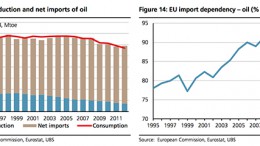
MADRID | The Corner | Winter’s coming and Europe finds itself in a complicated position. The (declining) production of the continent’s energy import has traditionally fallen short of (growing) consumption . In 2012, 53.7% ofEurope’s energy consumption was based on imports – up from in 44% in 1996, according to UBS. Brussels admits the share of imported energy is likely to rise to 100% in oil and above 80% in gas by 2030. 


No Picture

Bank of Spain may adopt Euribor Plus index

MADRID | The Corner | The BdE is working on the possibility of establishing a new reference index known as Euribor Plus. The main characteristic would be the form of calculation, which would only take into account prices (interest rates) for transactions instead of reference prices announced by financial institutions.


janet yellen TC

Yellen likely to focus on jobs today; markets get comfort from Bullard: nothing changes

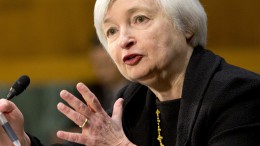
MADRID | The Corner | Markets expect more dovish rhetoric from the Federal Reserve’s chairwoman Janet Yellen, who is addressing a Boston Fed conference on income inequality today. The fact that she has put the issue into the mainstream has earned support from working class communities. Visiting an under-privileged neighborhood on Thursday, she eschewed the chance to talk about monetary policy, but instead listened to stories about layoffs and lost savings.  Wall Street took some comfort from the St. Louis Fed President, James Bullard, who said that the Federal Reserve should consider delaying the end of bond purchases, given declining inflation expectations.


china mercado recurso TC

China’s Challenge: Growing the Market, Limiting the State

BEIJING | By James A. Dorn via Caixin | In his new book Markets over Mao: The Rise of Private Business in China, Nicholas R. Lardy, one of the world’s leading China experts and a senior fellow at the Peterson Institute for International Economics, makes a strong case that the market, not the state, has been the key factor in the country’s remarkable rise. In 1978, Beijing began to loosen its grip on economic life and paramount leader Deng Xiaoping recognized the failure of central planning as a development model. Today China is the world’s second-largest economy, and the range of choices open to consumers has greatly expanded under economic liberalization and trade.