
Markets

No Picture

ECB: credit standards on EZ loans eased for the first time since 2007

MADRID | The Corner | A further sign of a recovery in credit: standards on loans within the eurozone have been eased for the first time in the 2Q in seven years, just before the financial crisis bursted, the ECB said in its regular Banking Lending Survey released on Wednesday. Net demand continues to recover for both household and enterprise borrowing. However, as we reported, the open bar announced by Mr Draghi won’t have an impact on loans until 2015 and, meanwhile, credit fall continues to accelerate in some peripheral countries, especially in Spain and Italy.


bankia

Spanish Bankia’s good results irritate non rescued banks

MADRID | By Francisco López | For a few, Bankia has quickly accomplished the miracle of the loaves and fish thanks to a faultless management. For many others, the bank achieved to improve its results in the last two years “thanks to the King’s gunpowder” – an old Spanish idiom meaning one takes advantages of others’ resources but doesn’t value them –. Taxpayers paid €22.4bn, an amount far higher than the lender’s financial gap, which has given back a tiny amount so far. At least, it has overhauled its budget.


No Picture

The (bonds) Hunger Games

MADRID | The Corner | In the next few days demand for Spanish bonds is expected to grow, since Spanish debt auctions will be held and European CPI data showing that prices remain very low will be released.


MA

M&A market reaches 2008 levels

MADRID | The Corner | In one of the best symptoms of economic recovery, companies are leaving risk aversion behind and buying others to grow. In the first six months of the year, M&A operations reached $1.75 trillion worldwide, 75% more than during the same period of 2013. The pharma sector is in pole position, with multiples reaching 21.3x PE globally vs. 16.1x in 2013, and 4 of the 10 largest operations announced for 2014. According to JP Morgan, if we annualize 1S volume, operations could total $3.642 trillions by the end of the year.


govies

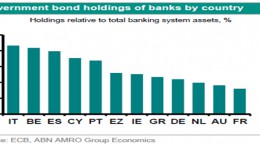
EU banks reach debt holdings all-time high

MADRID | The Corner | European banks have increased their holdings of govies in June by +0.1% m/m (+1.4% y/y), with one somewhat higher increase in the periphery (+ 0.6% m/m and – 1.2% y/y), mostly of a +8.6% in Ireland and +1.8% of Portugal. According to the ECB, EU lenders have reached a new all-time high of 1.8trn debt holdings, while peripheral banks are approaching 2013 numbers (€830bn vs €840bn in June 2013).


stoxx600SP500afi

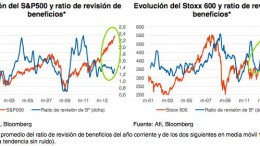
70% of Stoxx600 firms see profit hikes

MADRID | The Corner | Reporting season in Europe is beginning. Over half the Stoxx600 companies that already showed results surpassed expectations. Profits grew for 70% of this businesses and the average rise was of 9%.  European markets’ upward trend being less mature than American’s may point at a EuroStoxx higher appreciation potential. It gains importance as performance results keep looking up and prices context allows EZ companies to rise EBITDA margin from current 15.2% to prior years levels (above 16%).


yuan dollar paperplane

RMB as reserve: Rebalancing the global financial system

By Peter Wong via Caixin | It is unlikely that the RMB or yuan, China’s “people’s currency,” will replace the dollar outright as the world’s only investment and reserve currency any time in the foreseeable future. But there is every indication that the dollar will have to make room for a second global reserve currency within the next 15 years. A revolution allowing investors to diversify risk – and creating a system with more choice and better ability to resist shocks – should be welcomed.


No Picture

EM: High yields offer some shelter

LONDON | By Koon Chow at Barclays | A pertinent question asked by some investors is whether EM markets have become complacent again and whether new exogenous shocks may catch investors at a vulnerable point just as they are settling down to ‘summer’ carry trades. We see this risk in some markets but it is far from a universal theme in our view. In EM local markets – FX and bonds – we see Turkey as probably the most vulnerable to exogenous risk aversion. At the other end of the spectrum are Brazil, Central Europe, and Colombia, which do not appear vulnerable in part because of the high local real yield levels.


russia

Russia: the real effects of sanctions

MADRID | The Corner | The EU is considering harder sanctions on Russia after the downing of a Malaysian airliner in Ukraine. What are the effects of the current and potential further sanctions on the Russian economy and, in general, on Emerging Markets (EM) sovereign external debt? Co-CIO Deutsche Asset & Wealth Management’s Asoka Wöhrmann weighs in. (Illustration: Iain Green at The Scotsman)