
Reported by Julia Pastor
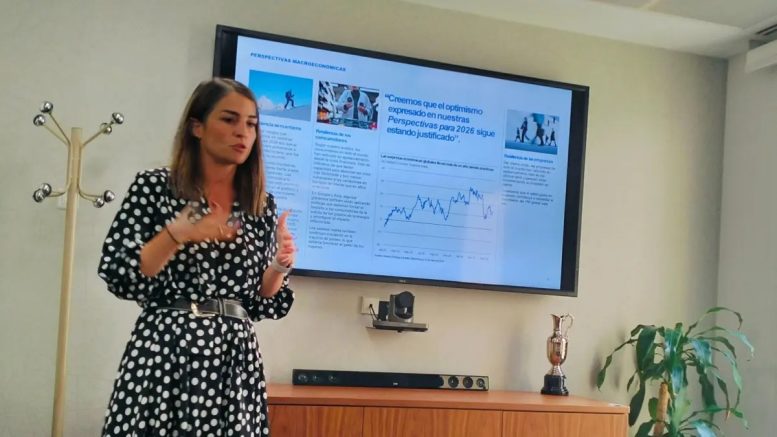
Invesco’s outlook for the second half of the year has changed little from that published by the firm at the start of the year. The outlook for economic growth and inflation is less favourable now, but not enough to trigger negative returns on global equities. Thus, and despite all the disruptions that have occurred up to July (the rapid advance of AI, geopolitical tensions and their impact on shipping routes through the Strait of Hormuz, etc.), its analysts maintain their view of resilience across all global markets.
“The acceleration hasn’t disappeared; it’s just on hold. Inflation and the energy crunch have only slightly slowed down the economic acceleration we were seeing at the start of the year. As soon as the situation eases, it will return,” says Macarena Velasco, senior director of ETFs for Iberia and Latin America at Invesco.
Furthermore, central bank decisions will be the main driving force behind economic movements, particularly those of the Fed. According to Velasco, “we must never try to go against the tide set by central banks because they are the ones who set the cost of capital, and the cost of capital ultimately determines variable-rate yields, asset valuations and fixed-income returns”. With a more contained inflationary scenario, gradually easing from 4% to 3% towards the end of the year, Invesco does not see any need for central banks to raise interest rates very drastically. Forecasts point to only modest rises to control inflation: one or two by the Fed and the BoE, whilst the ECB remains on hold. These forecasts would change should inflation spike due to a renewed escalation of the conflict in the Strait of Hormuz.
For his part, Fernando Fernández Bravo, head of active distribution for Iberia at Invesco, forecasts a weak US dollar, at levels of 1.25 or even 1.30, which could particularly benefit emerging markets for various reasons. “Many emerging market governments borrow in US dollars, so a weaker dollar reduces their repayment costs in local currency. Furthermore, when international currencies are stronger, imports can become cheaper, which eases inflationary pressures,” he explains.
So far this year, returns in emerging markets have been very strong, particularly in South Korea and Taiwan. At present, the Kospi index and South Korea carry greater weight than the China index in the MSCI Emerging Markets Index, having risen by 100 per cent, and by more than 50 per cent in 1H26, thanks to companies such as TSMC in Taiwan and Samsung and SK Hynix in South Korea. These are hardware companies that are exporting to data centres at rates three times higher than in recent years; in other words, they are effectively setting their own prices. For this reason, Invesco has already moved to underweight these markets. “It is not sustainable in the medium to long term, however much we may like hardware. These markets are very expensive and we may be facing a bubble.”


