
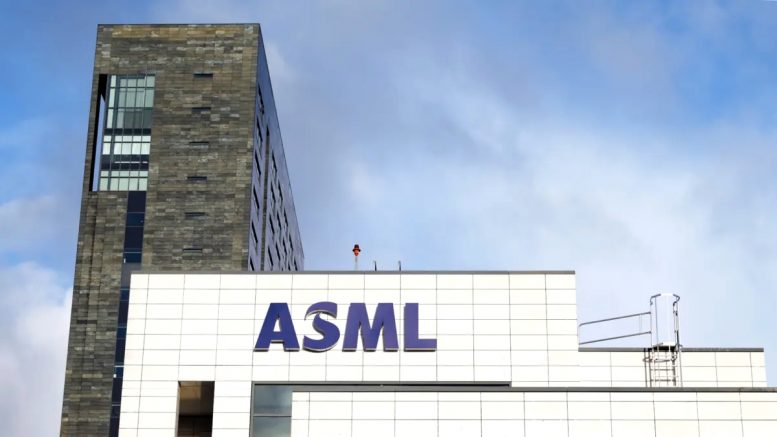
Although AI is often associated with names such as Nvidia, SK Hynix, Samsung or TSMC, behind them all lies a key European player: ASML, whose technological position is unique in the world and which “has no competitor for its most advanced products”.
By Alexis Bienvenu
The artificial intelligence revolution has its own stars: Nvidia for processors, SK Hynix and Samsung for memory, and TSMC for chip manufacturing. However, behind these giants lies a key player on which they all depend – a company, who would have thought it, from Europe: ASML.
With a market valuation estimated at almost 50 times the expected earnings per share in 2026, according to the consensus compiled by Bloomberg, it ranks among the most expensive European blue-chip stocks. Its year-on-year rise of almost 130 per cent (as at 8 July) places it at the very top of the European market capitalisation rankings, with a current value of around €600,000 million. It thus lags far behind the US giants, but is well ahead of the rest of the European stock market. What accounts for this remarkable performance? Primarily, the fact that its position is unique in the world. Whilst the giants of the digital sector compete with one another, ASML has gained such a technological advantage that it has no competitor for its most advanced products.
The truth is that its business is far from straightforward: it manufactures the lithography machines used to produce electronic chips. To do this, it uses cutting-edge technology known as Extreme Ultraviolet (EUV). However, generating this type of radiation is no mean feat: microdroplets of tin are struck by a laser to create a plasma that briefly reaches a temperature higher than that of the Sun’s surface. This light is then used to etch the world’s most sophisticated electronic components. Without ASML, there would be no state-of-the-art NVIDIA chips, nor advanced production at TSMC, Samsung or Intel. In the global AI gold rush, ASML does not sell the chips: it produces the machines that, in turn, manufacture the chips.
The most surprising thing is that ASML was not destined to dominate this market. Founded in 1984 as a joint venture between Philips and ASM International, it was a complete unknown compared to the Japanese giants Nikon and Canon. However, the Dutch embarked on a colossal gamble: investing in EUV technology for nearly twenty years despite the difficulties and its enormous costs. When the technology finally reached maturity, ASML’s lead became virtually impossible to catch up with. Nikon and Canon never managed to get back into the race.
In reality, this success is not just Dutch: it is European. The high-precision optical components come mainly from the German company Zeiss, the high-power lasers are supplied by the German firm Trumpf, whilst a dense network of suppliers is spread across the Netherlands, Germany, Belgium and France. Europe shines here in all its splendour: industrial cooperation between its companies has made it possible to create one of the most complex technologies ever developed.
Furthermore, ASML’s success is not limited to new machines. A significant proportion of its equipment has been in production for decades. In this way, the group generates recurring revenue from maintenance, spare parts and the modernisation of an installed base that is unique in the sector. And the story does not end there, as ASML is already working on the next generation of its equipment: machines known as ‘High-NA EUV’, which are extremely expensive (around €400 million each – more than a modern large-capacity passenger aircraft) and which will further consolidate its dominance.
It is true that this dominance is not without risks. For example, the semiconductor market could slow down, Taiwan could come under attack – which would weaken TSMC – or China could narrow its technological gap in this field; but, in any case, ASML’s lead would not be threatened for many years to come.
At a time when Europe appears to have been left behind in the digital race, overtaken by the US, China and South Korea, a light-specialist such as ASML shines as a dazzling counter-example: without this European star, no digital revolution is possible. An inspiring beacon for industry on the Old Continent.


