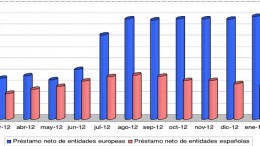
Spanish banks cut again ECB loan addiction
The Spanish banks’ correction in February was 5.2 percentage points higher than the average in the eurozone.

The Spanish banks’ correction in February was 5.2 percentage points higher than the average in the eurozone.

MADRID | By J.L.M. Campuzano | Fitch’s decision to downgrade Italian debt from A – to BBB + last Friday didn’t come as a big surprise. Nor did the negative outlook. However, it does pose a warning about the fundamental problems of this country and of the rest of the eurozone, where authorities and investors are currently showing a disturbing complacency/conviction in a better future.

BARCELONA | By CaixaBank research | Compared with its pre-crisis size, the balance sheet of the Federal Reserve in the US has tripled while the European Central Bank’s has only doubled.

MADRID | By Tania Suárez | Profim EAFI’s head of financial analysis José María Luna said in an interview for consensodelmercado.com that the ECB should cut interest rates the sooner the better.

LONDON | Behind the option of recovering the public investment made in Lloyds TSB, a possibility sounded today by Whitehall amid better priced bank stocks, there is the European Central Bank. But British taxpayers will probably never know.
The prime ministers of France and Portugal announce further adjustments for 2013, as Spain did before. But, analysts at CaixaBank note, the lack of detail isn’t encouraging for investors or other euro zone partners, despite the support the ECB promises.
The ECB reduced official interest rates by 0.25%, but the interest rate spread for loans to firms and households has widened. Credit conditions vary from one country to another in the euro area. The European governments have to fulfil their duties if the euro is to stabilise.

BARCELONA | Analysts at CaixaBank welcome the European Central Bank’s decision of propping up state debt by moderating its cost in the markets. It will give the euro zone room to progress in its integration.
By Luis Arroyo, in Madrid | Very briefly: for those who have let themselves fall for the euphoria that unfolded after the European Central Bank governor Mario Draghi reported on unlimited short-term sovereign bond purchases, I would like to remind them of what happened during the last weeks of 2011 and the beginning of 2012. Back then, the ECB introduced its long-term refinancing operations, which were meant to inject liquidity…
LONDON/MADRID | President Mariano Rajoy should manage to take this week a breath, although it will probably feel too weak. A simple look at the curve of Spain’s government debt now shows a steep upward gap between the internal rate of return of two-year bonds and the cost of the medium and long-term credit for the country. Indeed, 24-month debt paper’s IRR has tightened by more than 450 basic points…