
Waiting for the Greek elections
MADRID | By Álex García.

MADRID | By Álex García.

LONDON | Barclays analysts | The European Court of Justice has already published its opinion about the Outright Monetary Transaction (OMT): the ECB’s anti-crisis plan was “necessary” and “in principle” is in line with EU law. This much awaited opinion will have important implications for any broad-based ECB government bond purchases (QE), which we think are likely to be announced next week.
ATHENS | By Nick Malkoutzis | Prime Minister Antonis Samaras has a habit of defending his government by saying that his aim is to make Greece “a normal European country.” Whatever he may mean by this and however genuine he may be in wanting Greece to recover from its long crisis, this is an infuriatingly patronising comment. Intentionally or not, it aligns Greece’s prime minister with all the cranks in Europe and Greece’s misinformed critics beyond who view the country as some kind of basket case.

MADRID | By Luis Arroyo | When many were speaking of a new Japanese recession and the failure of Shinzo Abe’s bold Keynesian policy, his Liberal Democrat Party obtained a sweeping victory at the polls on Sunday. In Europe, the Abenomics are in austerity fans’ crosshairs because if these policies happen to work they would look ridiculous. They were delighted when Japan’s GDP contracted in 3Q. But I’ve been following the Nippon economy for some time and I don’t really rust quarterly figures.
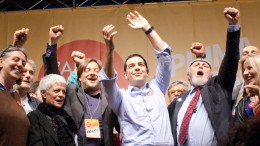
ATHENS | By Nick Malkoutzis via MacroPolis | When Greece returned to international bond markets in April this year after a four-year exile, it was trumpeted by Prime Minister Antonis Samaras as another step towards the crisis exit door. “Confidence in our country was confirmed by the most objective judge – the markets,” he said after investors snapped up three billion euros of five-year bonds with a coupon of 4.75 percent. Exactly seven months later, though, the yield on those bonds shot up to almost 10 percent. Suddenly, the markets do not seem so confident. So, what went wrong?
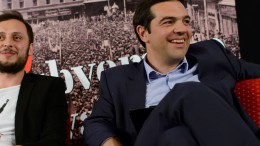
ATHENS | By Nick Malkoutzis via MacroPolis | Syriza leader Alexis Tsipras is following a well-trodden route by trying to force early elections over the presidential ballot. Several others before him have tried to exploit the loophole in the Greek constitution which means that snap polls have to be held if 180 MPs cannot be found to back a presidential candidate. The most recent opposition leader to follow this tactic was PASOK’s George Papandreou in 2009.

WASHINGTON | BNP Paribas analysts | Republicans won control of US Congress this week. Latest projections suggest the GOP has taken over the Senate. Given that the Republicans are very likely to retain a working majority in the House, we can expect the party to control both houses of Congress at least until the end of 2016. A severe budget showdown is unlikely.

MADRID | By Sean Duffy | A faltering economy, a plummeting currency, skeptical markets and a polarized electorate are just some of the issues observers are focusing on this weekend as Brazilians go to the polls in what has been labeled the tightest election for a generation.
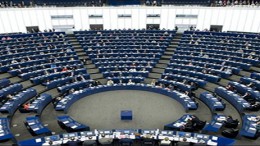
MADRID | By Julia Pastor | For the first time European citizens will elect the successor of the European Commision’s president Jose Manuel Durão Barroso. The upcoming elections of May 25 will have two candidates, one for the socialist party, Martin Schulz, and another for the conservatives, Jean-Claude Juncker. This change of direction is not the result of a reform or a pact in the back room but of a consensus decision. Hopefully, the US could no longer say they don’t have a European direct interlocutor.

COPENHAGUE | By Kim Faber, Tanja Parker Astrup and Jakob Sheikh at Politiken via Presseurop | With 29.5 per cent of the vote, the Social Democrats led by Prime Minister Helle Thorning-Schmidt avoided a long-predicted catastrophe in Danish local elections on November 19, reports Politiken.