Truce in the euro area’s peripheral debt markets
Rating agencies keep Spain’s credit rating at investment grade. The stability of the United States’ debt market, threatened by the fiscal cliff.

Rating agencies keep Spain’s credit rating at investment grade. The stability of the United States’ debt market, threatened by the fiscal cliff.
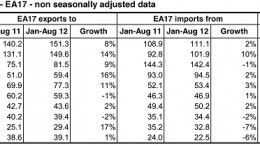
EU exports to most of its major partners grew in January-August 2012 compared with January-August 2011, except for India (-5%). The most notable increases were recorded for exports to Russia and South Korea, both +18%.
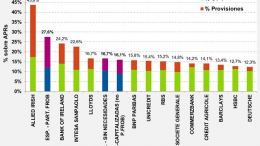
LONDON | In spite of bad economic figures for the euro zone, more peripheral banks may be enjoying access again to wholesome market credit. Spain continues under the spotlight, though, and the situation could become rather difficult.

MADRID | The Spanish government faces an uncomfortable dichotomy, says Carlos Díaz Güell: it either prolongs the fiscal measures taken in 2011 or lets the public deficit grow even further.
CaixaBank research | The current surplus reaches almost 60 billion euros, close to the peak of 2004. Rising oil prices and the euro’s appreciation might slow up the pace of growth in the current surplus.

Euro area and European Union government deficit has reached 4.1% and 4.4% of GDP, respectively. Government debt is at 87.3% and 82.5%, according to Eurostat.
BARCELONA | The research analysts at la Caixa remind investors of how comfortably (88.2 percent) euro area debt per GDP compares against US’ over 100 percent and Japan’s over 200 percent. But Europe is too unbalanced to survive as it is.

By CaixaBank research team, in Barcelona | Economic slowdown is difficult to stabilise within a context of rising uncertainty that hampers aggregate demand. Economic activity slowed down in the first quarter of the year with negative growth of 0.1% year-on-year, as shown by the detailed figures for gross domestic product in the first quarter. Private consumption continues to adjust, shrinking by 0.6% year-on-year. Gross fixed capital formation has also decreased…

By Tania Suárez, in Madrid | Fernando Luque is analyst and editor for Morningstar. In a conversation with The Corner, he said that Greece will not withdraw the euro because “that possibility is no good for anybody, neither for Greece, nor for Germany.” Luque explains that there are no shortcuts to solve the Greek crisis, but that will not necessarily damage other peripheral countries such as Italy or Spain. Question.-…
The seemingly dead weight of the peripheral economies continues to mark a divide within the common currency region. The overall picture, unavoidably, registers the cut. GDP fell by 0.2% in both the euro area and the EU during the second quarter of 2012, compared with the previous quarter. Also according to flash estimates published by Eurostat Tuesday, in the first quarter of 2012, growth rates were zero in both zones. Compared with…