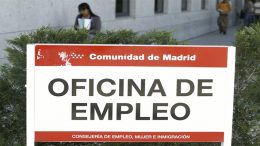
Social Security Enrollment In Spain Increases 0.8% in Second Quarter
According to the estimates of BBVA Research, social security enrollment increased 0.8% in second quarter , and unemployment reduced 1.6%.

According to the estimates of BBVA Research, social security enrollment increased 0.8% in second quarter , and unemployment reduced 1.6%.

The number of jobless people registered in the public employment services’ offices fell by 83,738 in May compared to the previous month (-2.5%). The total number of unemployed stood at 3.25 million end-May.
The number of Spanish unemployment fell by 47,697 in March in comparison with the previous month, according to figures from the Labour ministry. Figures of registered unemployed totaled 3.42 million, which was the lowest level of the last nine years.

A report from the European Commission published on Monday said that Spanish households’ gross available income was still below 2008 levels up to the first half of last year, in comparison with other EU countries’.
Spain ended 2017 with 611.146 more people in a job, a notable improvement on the results of the previous four years. The number of people signed on with the Social Security rose 3.4% to 18.460.201 from a year earlier.

Bankinter |The variation in the number of jobless in September (according to the Social Security register) was apparently slightly higher (worse) than forecast: +27.900 vs +21.500 expected vs +22.801 in September 2016. (That said it was slightly better than the 26.087 registered in September 2015).

Pablo Fernández | The “Report on the financial and banking crisis in Spain, 2008-2014” published by the Bank of Spain last May is 252 pages long, but omits important facts and dates. The most surprising thing is that it seems to assume that the financial and banking crisis in Spain was the result of “contagion” from the ‘”international financing crisis”.

James Alexander | Scott Sumner wrote an interesting blog post on his vision of macro. It is a useful way of seeing where Scott stands today. However, we were puzzled. Should unemployment really be the centerpiece variable or should it be stable nominal spending growth at an appropriate level?

“…One of the reasons for the high level of youth unemployment in Spain has to do with the fact that companies hardly get involved in the dual training system,” explains Hermann Simon the chairman of Simon-Kucher, the preferred consultancy firm of the “hidden champions,” those German mid-cap companies which compete globally. “Spain’s level of innovation is very weak…the whole country cannot live just off tourism services.”

I have read that since the arrival of Rajoy, the number of unemployed people has fallen by 1.3 million. Well done! But more than half of that corresponds to the drop in the Spain’s active population, who are not confident about finding work.