
Articles by Fernando Gonzalez Urbaneja

About the Author

Fernando Gonzalez Urbaneja
Over 30 years working in economic journalism. Fernando was founder and chief-editor at El País, general editor at the business daily Cinco Días, and now teaches at Universidad Carlos III. He's been president of the Madrid Press Association and the Spanish Federation of Press Associations. He's also member of the Spanish press complaints commission.
Araceli

Spain: A Confused And Weak Health Policy

Fernando González Urbaneja | The Sánchez government has given changing, confusing, changing and poorly explained responses, always tinged with a colossal self-esteem summed up in the boast that others are watching us and copying us… we are among the best… However, objective data and international statistics do not support this belief; on the contrary, Spanish performance is among the least fortunate.
catalan politicians prison

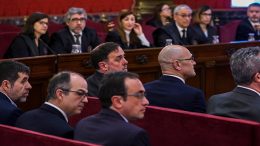
Pardons As A Positional Factor

Fernando González Urbaneja | Are you in favour of pardons, meaning that you are a “sanchista” (a faction of Spanish socialism)? However, if you are against them, then your position is more or less conservative or fascist, or perhaps liberal, to the right. It’s a simplification, but describes in a nutshell the bureaucracy in which Spanish politics is bogged down. Pardons, their legality, convenience, usefulness… occupy all the space for…


Indra Tecnocom

Should SEPI Launch A Takeover Bid For INDRA?

Fernando González Urbaneja | The INDRA case, the socialist government’s interest in occupying the company’s presidency by force, is indicative of a way of understanding public management and exercising power. “Because you are who you are”, that is, because I have the power and I feel like it. SEPI (the Treasury, the government, the PSOE-PSC) has a stake of just under 20% in INDRA that goes back a long way,…


Calviño

Nadia And Yolanda, At The Boss’ Right And Left Hand

Fernando González Urbaneja | The second (Nadia Calviño) and third (Yolanda Díaz) vice-presidents of the Spanish government have a hard time putting up with each other; they hide it, but sometimes they betray each other. A gesture, a comment, a confidence… and the dissimulation vanishes. It happened yesterday in Parliament, over the “reversal of the labour reform” but it is well known to the usual interlocutors of the two vice-presidents….


Pedro mascarilla españita

Sánchez, Between Polls And Pardons

Fernando González Urbaneja | The spring promised to be a prosperous one for the socialists after the relative triumph in the Catalan elections, which held out the possibility of a tripartite government (on the left); the ousting of the Partido Popular in some autonomous communities in collusion with Ciudadanos, which, by the way, distanced itself from the PP; the vaccination campaign that would put an end to the pandemic; and…


Pedro mascarilla españita

Spain: Early Elections Due To Coalition Exhaustion?

Fernando González Urbaneja | The first reaction of the socialists after the Madrid elections was to distance themselves, almost indifferent, with the argument that Madrid is not Spain. That was the end of it. But it did not hold water. Third in Galicia, opposition in Catalonia, minority in the Basque Country, opposition in Andalusia… and third in Madrid. So much for a governing party. And too much to sustain the…


pensioners

The Silent Reform Of Pensions

Fernando González Urbaneja | Spain has a priority, essential employment problem: high chronic unemployment and job insecurity. Both of these are among the essential causes of a blushing inequality, among the worst in Europe. Then, to complicate the solutions, comes the problem of the high public deficit, which has increased over the last decade as an inevitable inevitability. A debt aggravated by its dependence on external financing with a bias towards instability. At the heart of this debt is the chronic deficit accumulated over the last decade in the pension system, which widens its deficit every year.


Bipartisanship

The Resistance Of The Imperfect Bipartisanship In Spain

Between 2014 (European elections) and the last general elections (December 2019) there have been six elections in which the sum of the bipartisanship oscillated between 45 and 55%. With an electoral support of around 30% of the votes (for the most voted party) and around 50% of the sum of the two parties (compared to more than 70% during the previous forty years) both parties continue to be essential to govern. Both still have a social and electoral base to survive despite their evident management errors.


spain modernisation

Spain Needs A Big Modernisation Operation To Gain Productivity

Fernando G. Urbaneja | Before the pandemic, the Spanish economy showed signs of weakness and exhaustion, which are now considered as pronounced. Spain needs a major modernisation operation to gain productivity, to generate stable employment and add value. And this is not being talked about much. Many decrees but no script, no basic project, no fine print. European funds are important, but knowing how to avoid wasting them, is even more important. 


coronavirus susto

A Notch or a Hole

Fernando G. Urbaneja | Economies around the world, and in Europe in particular, have been improving for less than a year, the recovery after the Great Recession peaked, to weaker growth times, including some local recessions (for example in Italy). The causes were known and repeated: trade war, Brexit, insufficient and confused fiscal policies, geopolitical uncertainties. But the “black swan” was missing, the unforeseen that becomes a necessary excuse, the scapegoat, for a trend change and even an end of cycle.