debt

argentina

Argentina: Griesa’s ruling sets dangerous precedent in debt restructuring processes

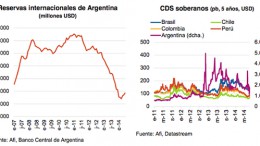
MADRID | The Corner | Many got it all wrong: the problem with Argentina is not the so-called “second default in 12 years,” but U.S. District Judge Thomas Griesa’s ruling. The country will need to pay holdouts $1.33 billion plus interest. And that sets an extremely dangerous precedent for future restructuring processes of sovereign debt. No bond-holder will accept a haircut knowing that, at the end of the day, he could ask for the full amount. (Fig left: Argentina’s national reserves; right: sovereign CDS).



No Picture

Greece ponders how to deal with rising unpaid private debt, which hit 88 pct of GDP

ATHENS | Via Macropolis | Unpaid private debt in Greece is estimated to have reached around 160 billion euros, which corresponds to 88 percent of GDP, but was largely ignored until the last few days, when it became a key issue in the discussion between the government and the troika. Apart from the outstanding amount, the dynamic, which clearly shows a steady upward trend, is also a worrying factor.


No Picture

Defaults on instalment purchases fall by 25.2% in Spain

MADRID | By The Corner | The number of trade assets obtained on deferred terms and returned unpaid by households and companies plummeted by 25.2% in May, according to Spain’s National Statistics Institute (INE). Thus, defaulting in commerce puts together 25 months of year-on-year drops.


General government gross debt by sector of debt holder

No matter what, non-residents bet on French debt

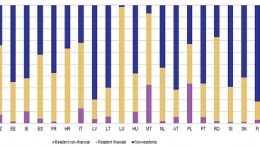
MADRID | The Corner | While  markets are expressing their concerns about the French economy, institutional investors seem quite comfortable about the Hexagone’s situation: the debt share of non-residents is 57.3 %, according to Eurostat. Finland and Latvia are the top choices with 81.6 % and 80.0 % of their debt owned by non-residents. Check the graph above.


No Picture

Falling debt against increasing GDP

MADRID | By Luis Arroyo | What good does it do a falling debt if nominal GDP is increasing? According to the Real World Economy in Greece, the households’ debt went as shown in the chart. That is, the nominal value of the existing debt has dropped, but it has increased in relation to the income or the GDP with which it is paid. And this, ladies and gentlemen, is the best expression of the Debt Deflation concept.


No Picture

Debt markets’ rally triggers bubble concerns

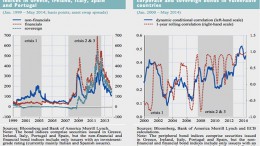
MADRID | By Francisco López | It is not the first time economists, analysts and authorities recently talk about a possible bubble in the debt markets. But the latest, strong drops in peripheral bonds, in all-time minimums, have prompted alarms: there is too much euphoria and fixed-income market’s last moves doesn’t make sense.


No Picture

China: Investing in the future

BEIJING | By Andy Xie via Caixin | Stimulus proposals won’t transform the economy in China, but spending on industrial research, building megacities and globalizing the white collar labor force will.


Austerity

What 20 years of austerity mean

MADRID | By Luis Arroyo | Despite Italy’s PM Matteo Renzi is the only one fighting the hard EU economic line, Italian public debt reaches 135% of GDP. The country is required by the fiscal compact to return to 60% in 20 years, which would involve perpetual austerity for an entire generation at least. However, the problem does not only affect Italy but all the European Southern countries.


debt

ECB joins the warning: beware of cheap debt

MADRID | By The Corner | As the Spanish sovereign bond is at minimums (2.8%) and the volume of debt has attained maximums (98%), Bankinter analysts point that low rates along with the large volume of issuances make European fixed income highly sensitivity to the risk premium ups and downs. High yield European firms are placing their bonds at historical minimum of 3.73%, when the average of the last 15 years is 10.19%. One of the risks the ECB is highlighting is the return of financial instruments that boosted banks’ leverage and resulted in the 2007 economic downturn. 


No Picture

Market chatter: Debt, stock and currency markets in full swing

MADRID | By Jaime Santisteban | Spanish Treasury broke a new record on Thursday amid the ECB’s easing hopes. “Spanish bonds reduced spread vs. the equivalent German benchmark almost 20 points in just a couple of days. Stock markets are moving forward without a clear direction, although uncertainty is smaller than in public debt markets” The Corner senior analyst Francisco López explains.