
World economy

zero rates

Do Low Interest Rates Really Penalise The Financial Sector That Much?

Are extremely low interest rates good or bad for the economy? Is is it true that they are seriously damaging the profitability of the banks and insurers? The debate over the suitability of the zero interest policy driven by the central banks is heating up between the monetary authorities and the financial sector.


debt pile up

World Debt’ Enigma: What Has Been Done With The 100% Since 2008 ?

The IMF estimates world debt at over $150 billion as can be seen in the graphic below. This represents approximately 250% of global GDP. And it’s easy to see that the bulk of it is private debt. It’s also clear that debt jumped massively when the crisis broke out in 2008 and has continued to grow since then. In 2008, debt was less than 150% of GDP.


US productivity

Why Is US Productivity So Weak?

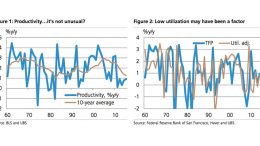
UBS | Since 2010 US productivity growth has been just over 1%, a deceleration not only from the long-term average but also weaker than the rate of productivity growth seen in the 70s and 80s. That said, a 10-year average does not look too low relative to history.


democracy concept

How Can Democracy Go Wrong?

Ahmed Ezzeldin | We usually expect elected politicians to represent the choices of the people and remedy the historical sins of brutal dictatorships that dominated the world for most of its history. Is that the case?


Eurozone inflation

Fighting Disinflation

J. L. Martínez Campuzano (Spanish Banking Association) | Little by little it’s being acknowledged. Just this Thursday, the President of the ECB openly admitted that monetary policy has its limits in terms of driving growth and stimulating inflation. And in fact, history tells us that monetary policy is more efficient for fighting inflation than for creating it.


government.concept

Should Governments Do Something About Growth?

Central bankers deserve praise for salvaging the economy when it was navegating rough waters. The massive liquidity glut they provided undoubtedly saved the day. Yet this funding bonanza seems unable to boost growth. We know that money doesn’t necessarily bring happiness. But now we discover, much to our dismay, that neither does it guarantee a full- steam recovery.


US jobs

China Spending To Help Boost American Job

Henry M. Paulson Jr via Caixin | Trade does result in very real and serious job losses, while its benefits are spread more broadly over the entire U.S. economy. Yet many job losses are not a result of trade; they are actually driven by productivity gains related to rapid advancements in technology, a powerful force disrupting labor markets globally and affecting numerous countries, including the U.S. and China.


hilaria donaldo

Evolution In US Polls: Too Close To Call?

AXA IM | At the time of writing, Hillary Clinton enjoys a near 2 point lead over Donald Trump in the national polls. This lead had narrowed to almost a 1 point gap recently – the smallest since the brief lead Trump held over Clinton at the time of the Republican convention. The polls appear equally tight if we look at the likely battleground states. Exhibit 2 illustrates a mixed picture in terms of Clinton or Trump leads in key US states.


bancoscentrales

A Global Financial World (Or The Herd Instinct In The Markets)

J.L.M. Campuzano (Spanish Banking Association) | You will agree that the messages we are getting from the main central banks fuel more distrust than certainty. The scenario is complex. And part of this complexity comes precisely from the current uncertainty which translates into a greater correlation between the financial markets and assets at a global level.


US protection 2

US Trade Protectionism Is Bad For Emerging Markets

AXA IM | Given the importance of trade in connecting the world economies, rising protectionist rhetoric in the US presidential election is particularly alarming. Both candidates, Hillary Clinton and Donald Trump, have made anti-trade and Free Trade Agreements (FTAs) remarks during their respective campaigns: