
debt

JJ Ruiz

“A debt crisis in LatAM is still on the very distant horizon”

For the last four years, Jose Juan Ruiz has been chief economist at the Inter-American Development Bank (IDB), the largest multilateral development aid agency in the region, surpassing the World Bank. Despite the fact LatAm has suffered a massive shock, one of the biggest differences this time round compared to previous slowdowns is that the region has $600 billion of international reserves.



Abengoa

Abengoa Is Saved By Its Creditor Banks

The demise of Abengoa, the Spanish engineering and renewable energy firm, would have been a massive blow for its creditor banks. So the government and the banks have been working on a solution since the company entered pre-insolvency proceedings. The deal agreed this week hands over the majority of Abengoa’s capital to its creditors.


Max Otte

“It Is In Europe’s Interest To Keep New York And London Powers Away”

After the 2006 publication of his book “The Crash is Coming,” economist Max Otte became famous. In 2011 he launched another best seller, “Stop the Euro Disaster!,” which signalled the exit of Greece from the euro area and recommended that Spain return to the peseta. Otte has always argued that the euro has not united Europe.


Debt defaltion copia

The Loop Of Debt Deflation

Monetary policy is not equipped to control the real economy and the financial economy at the same time. Its aim is to moderate the fluctuations in real variables, GDP, employment and prices. But this destabilises the financial market, fuels speculation and increases household and corporate debt with the banks.


deuda spain

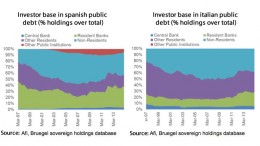
Italian Debt As An Alternative To Spanish Debt?

The current uncertain political panorama in Spain after the December 20 elections has not been reflected in any significant way in sovereign debt spreads. The yield on the 10-year bond compared with the German bund is around 130 bp, no more than 10-15 bp above the pre-elections level. One alternative to reduce (or diversify) exposure to Spain’s public debt may be take positions in Italian debt.


3546825418 8d1aa56b94 b

The toxic effect of Abengoa: markets worry about Spain’s companies

The global economy in general, and the Spanish economy in particular, are experiencing turbulent times. China, the emerging markets, raw materials, the weak recovery, inflation or exchange rates are entangled with the domestic problems of each individual country. In Spain, these are focused on a political map with a lot of question marks and a worrying level of private debt, which Abengoa’s crisis has accentuated.


bonos españa

Average cost of Spanish debt in circulation in 2015 at record low

The Spanish Treasury sold €2.102 billion worth of bonds at its last auction of the year, meeting its issuance target for 2015 of €139 billion. Its average issuing period in 2015 was 9.1 years, not seen since 2010, and it paid an average yield of 0.87%. This has meant that the average cost of debt in circulation has fallen to a record low of 3.16%.


brazils debt

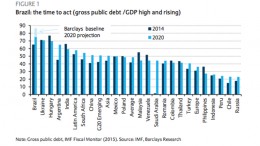
Brazil’s Unsustainable Debt Path

BARCLAYS | Brazil is confronting a toxic combination of a primary budg et deficit, high public debt (relative to EM countries), very high real interest rates (the Selic stands at 14.25%), sluggish trend growth, a negative commodity price shock and potential contingent liabilities for the sovereign, which together spell trouble for public debt dynamics.


madrid capital

Can Madrid survive without rating?

Fernando Barciela | Madrid leftwing Mayor Manuela Carmena (Ahora Madrid) upset the markets and the media last week with her decision to fire credit rating agencies Standard & Poor’s (S&P) and Fitch, effective from 2016.